
Projector vs TV
Which Is Better for Your Home Theater?
Choosing between a projector and a TV is not the same decision it used to be. For years, projectors were the obvious path for homeowners who wanted a large cinematic image. Today, large flat-screen TVs are brighter, sharper, easier to use, and more competitive in price than ever before.
For most homes, a premium TV is the stronger choice. It delivers excellent picture quality in more lighting conditions, works well for movies, sports, gaming, and streaming, and keeps the system simpler for daily use. A projector can still be the right answer, but it performs best when the room is designed around it from the start.
At Automated Living, the goal is not to push one display type into every room. The better approach is to design the right system for the space, the way the room is used, and the level of performance the homeowner expects over time.
Quick Answer: Is a Projector or TV Better?
For most home environments, a TV is better than a projector. A modern flat-screen TV usually offers stronger brightness, better contrast in normal lighting, simpler operation, built-in smart features, and a cleaner day-to-day ownership experience.
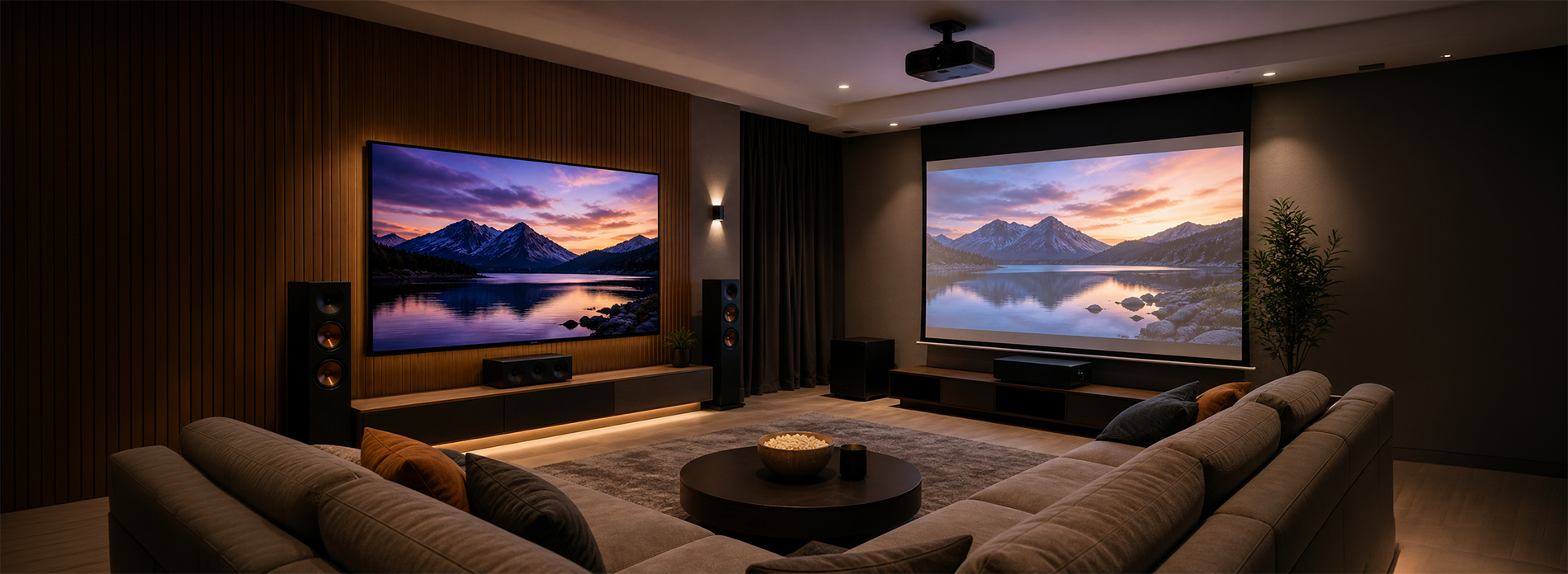
A projector is still a strong option when the goal is a true cinema-style image, especially at screen sizes above 100 inches. The key difference is that projectors depend much more heavily on the room itself. Lighting control, screen quality, seating distance, projector placement, audio design, and control integration all matter.
Projectors also tend to make the most sense when the budget accounts for the full system, not just the projector. A high-performing projector setup may require a quality screen, supporting audio equipment, proper wiring, lighting control, calibration, and a room that can be shaped around the viewing experience.
Choose a TV
Best for living rooms, great rooms, media spaces, family viewing, sports, gaming, and everyday entertainment.
Choose a Projector
Best when cinematic image size is the priority and the room can support controlled lighting, proper screen placement, supporting equipment, and professional calibration.
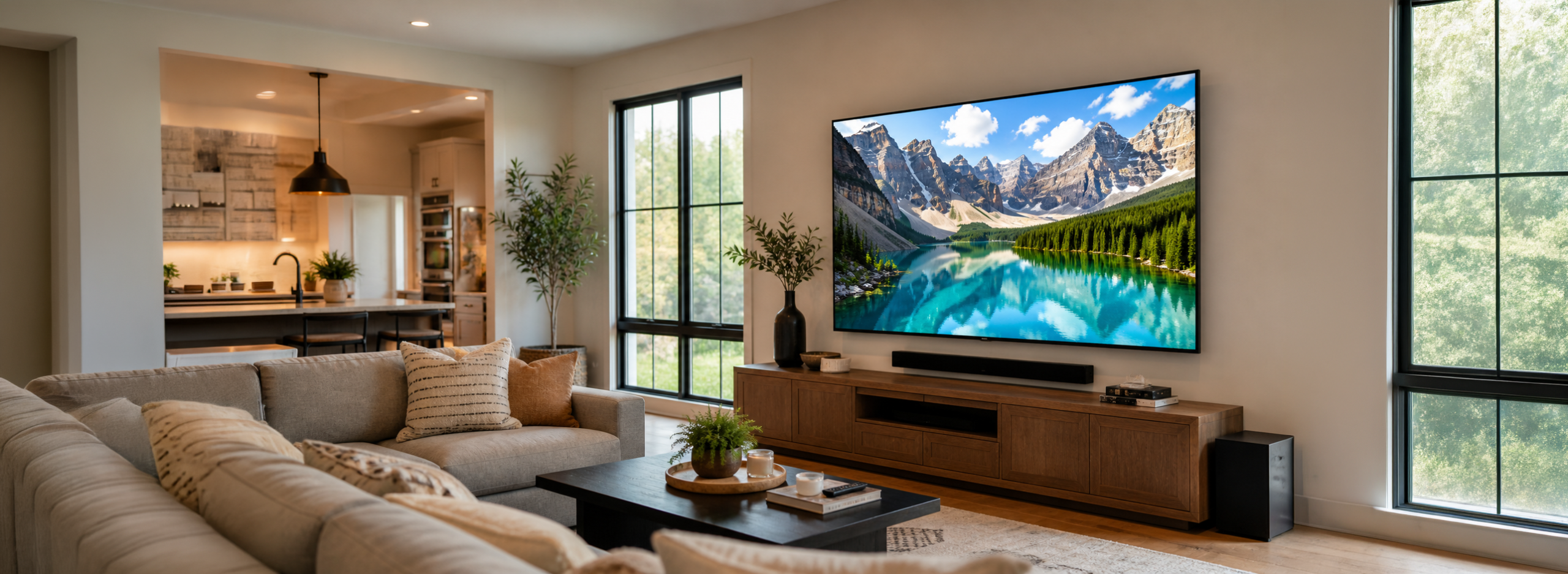
Why TVs Are the Better Choice for Most Homes
The strongest argument for a TV is consistency. A good TV looks excellent in more rooms, at more times of day, with fewer compromises. That matters because most home entertainment spaces are not fully dark, dedicated theaters. They are shared living spaces with windows, lamps, open floor plans, fireplaces, kids, guests, and multiple uses throughout the week.
Better in Real-World Lighting
Ambient light is one of the biggest challenges for projectors. Even a very good projector can lose contrast and depth when the room has daylight, overhead lighting, or reflections from nearby surfaces. A premium TV is far more forgiving in those conditions.
That difference is especially important in open-concept homes, great rooms, and shared family spaces. A TV can still look bright and clear during a weekend game, an afternoon movie, or a casual evening show with lamps on.
Simpler Daily Use
A home theater system should feel natural to use. Most families do not want to think about projector warm-up time, screen controls, light levels, source switching, or image adjustments every time they watch something.
A TV keeps the experience more direct. Streaming apps, HDMI sources, gaming consoles, live TV, and system controls can all be integrated into a simple interface.
Large-Screen Value
Large TVs have become a much more practical option for many homes. Sizes that once felt specialized are now common in media rooms and living spaces.
A 75-inch, 85-inch, or larger TV can deliver an immersive experience without requiring a projection screen, ceiling-mounted projector, strict light control, or the same level of room modification.
Cleaner Ownership Experience
A TV-based system can often be cleaner and easier to support over time. The display is self-contained, the image is stable, the room requirements are less demanding, and the installation can usually be integrated cleanly.
For most shared spaces, that balance is hard to beat.
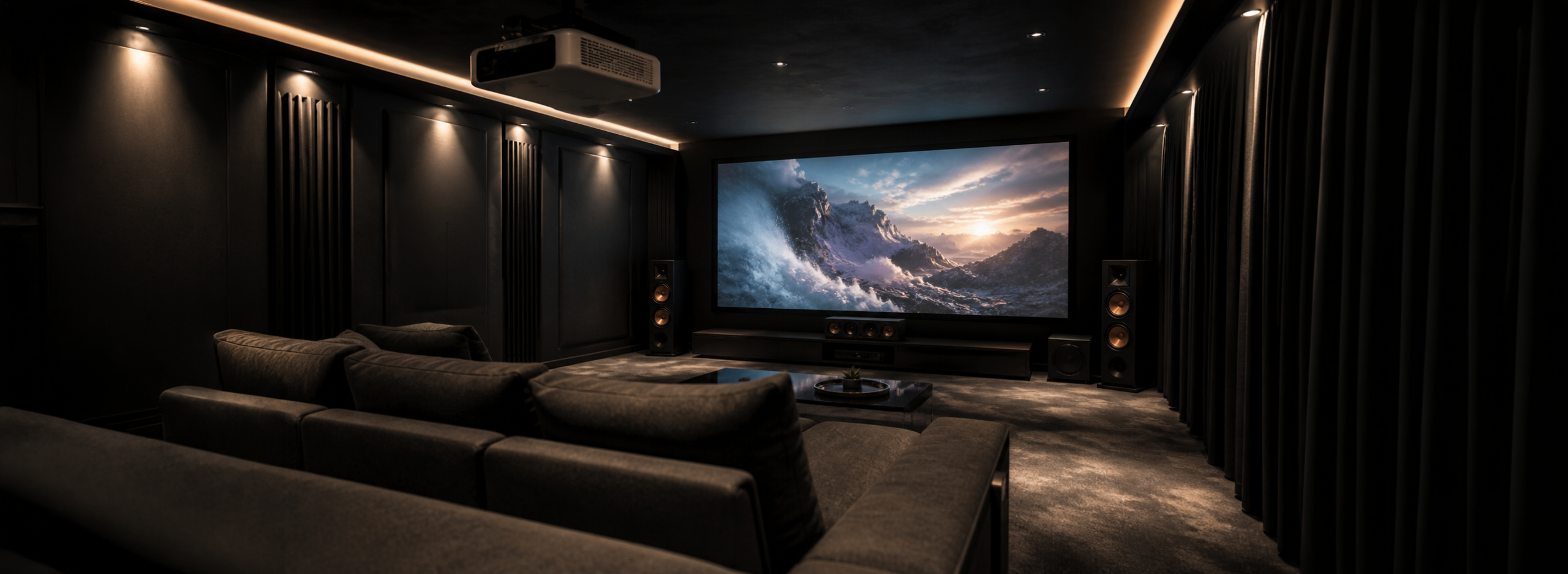
Where Projectors Still Make Sense
Projectors still have an important place in home entertainment. The difference is that they are more specialized. A projector is not automatically the better home theater choice simply because it creates a larger image. It is the better choice when the room, screen, lighting, seating, and sound system are planned around projection.
True Cinematic Scale
The main advantage of a projector is size. If the goal is a 100-inch, 120-inch, or larger image, a projector can create a sense of scale that even large TVs may not match.
Controlled Conditions Matter
A projector should be treated as part of a complete room design. The best results usually come from a space with controlled lighting, thoughtful seating distance, a quality screen, correct projector placement, clean cable routing, strong audio, and reliable control.
For a lower-level theater, a dedicated media room, or a purpose-built entertainment space, a projector may still be the right recommendation. That is especially true when the homeowner wants a dramatic screen size and is willing to shape the room around the viewing experience.
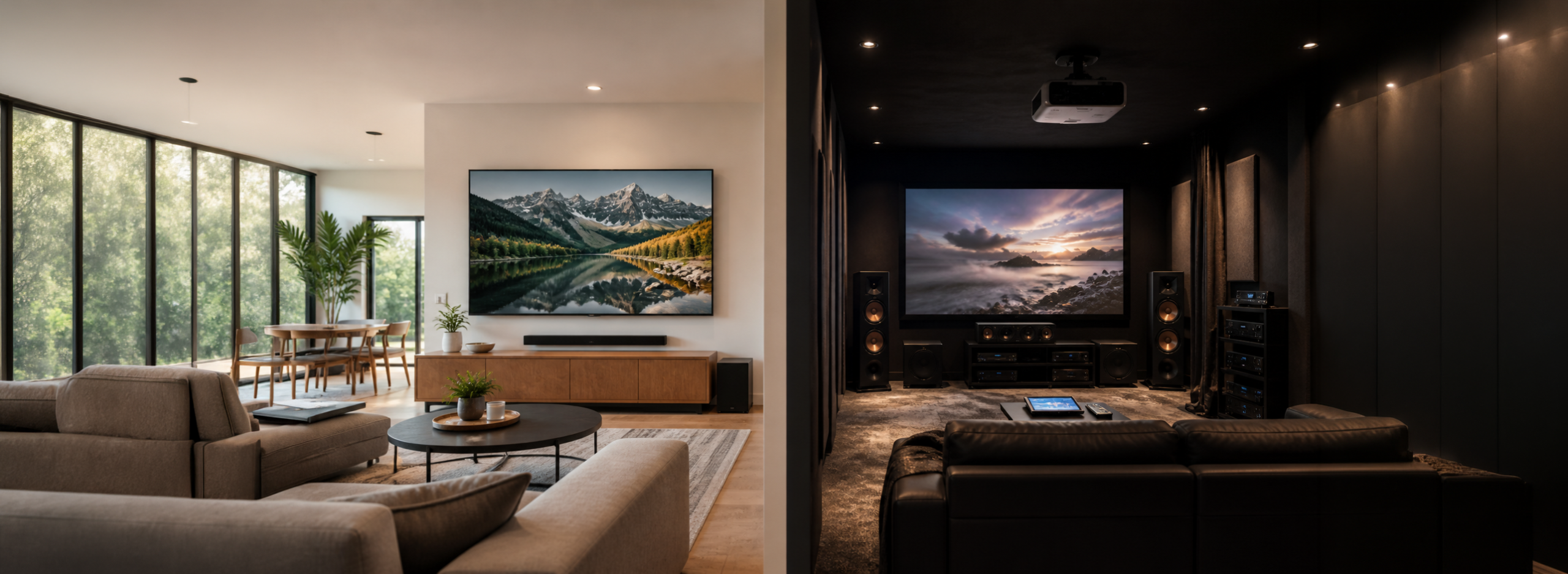
OLED vs Projector: Picture Quality or Screen Size?
The OLED vs projector comparison comes down to a simple tradeoff: picture quality versus image scale.
OLED TV Advantage
An OLED TV is usually the stronger choice for pure image quality. OLED displays are known for excellent contrast, deep black levels, precise pixel-level control, strong HDR performance, and a sharp, polished image.
In many rooms, an OLED TV will look more vivid and controlled than a projector because the image is coming directly from the screen rather than being projected across the room.
Projector Advantage
A projector can create a much larger image. That size can make movies feel more immersive, especially when the room is dark and the seating is arranged for a theater-style experience.
A projector becomes more compelling when maximum screen size is the priority and the room is designed to support projection.
For most homeowners comparing a projector vs OLED TV, the OLED TV is the better everyday display. It is easier to live with, more consistent, and usually stronger for mixed-use spaces.
Projector vs Smart TV: Convenience Matters
The projector vs smart TV decision isn’t only about image size. Day-to-day convenience plays a major role in how often the system gets used, especially in a shared living room, great room, or media space. A display that looks impressive but feels complicated can quickly become frustrating. The best system should make it easy to start a movie, stream a show, watch a game, or hand control to guests without explaining the room every time.
Everything Is Built Around Daily Use
A smart TV is typically the more straightforward choice because the display, apps, inputs, and picture controls are built into one familiar device. When properly integrated, it can become part of a larger control experience without adding unnecessary complexity to daily viewing.
- Built-in streaming apps
- Integrated HDMI inputs and source management
- Automatic software updates
- Easy smart-home integration
More Components Work Together
A projector is usually more of a complete room system than a single display. That can be a major advantage in a dedicated theater, but it also means more pieces need to be selected, installed, configured, and controlled properly.
Core pieces:
- Projector
- Projection screen
- Mounting location
- Power and cabling
System support:
- AV receiver or processor
- Streaming source
- Surround or architectural audio
- Lighting or shade control
None of this is a drawback when the system is professionally designed. In fact, these supporting components are what make a dedicated theater feel immersive, polished, and easy to control. But it does mean a projector is usually a more involved solution than a smart TV, especially in a room used every day by multiple people. For most households, that difference in convenience is one of the clearest reasons a premium TV is often the better fit.
Room Conditions Should Decide the Display
The best display choice depends less on the product category and more on the chosen space. A bright great room in the Missoula Valley has different needs than a dedicated lower-level theater or a lake cabin media space near Flathead Lake.
Before choosing between a TV and projector, the room should be evaluated carefully.
Lighting & Layout
- Natural light and window placement
- Overhead lighting and lamp use
- Wall space and fireplace placement
- Ceiling height
Viewing Experience
- Viewing distance
- Seating layout
- Screen size expectations
- Interior design goals
System Planning
- Speaker placement
- Network reliability
- Control preferences
- Future system expansion
Long-Term Use
A display should not be selected in isolation. It should fit the room, the audio plan, the lighting environment, the control system, and the way the space will be used over time.
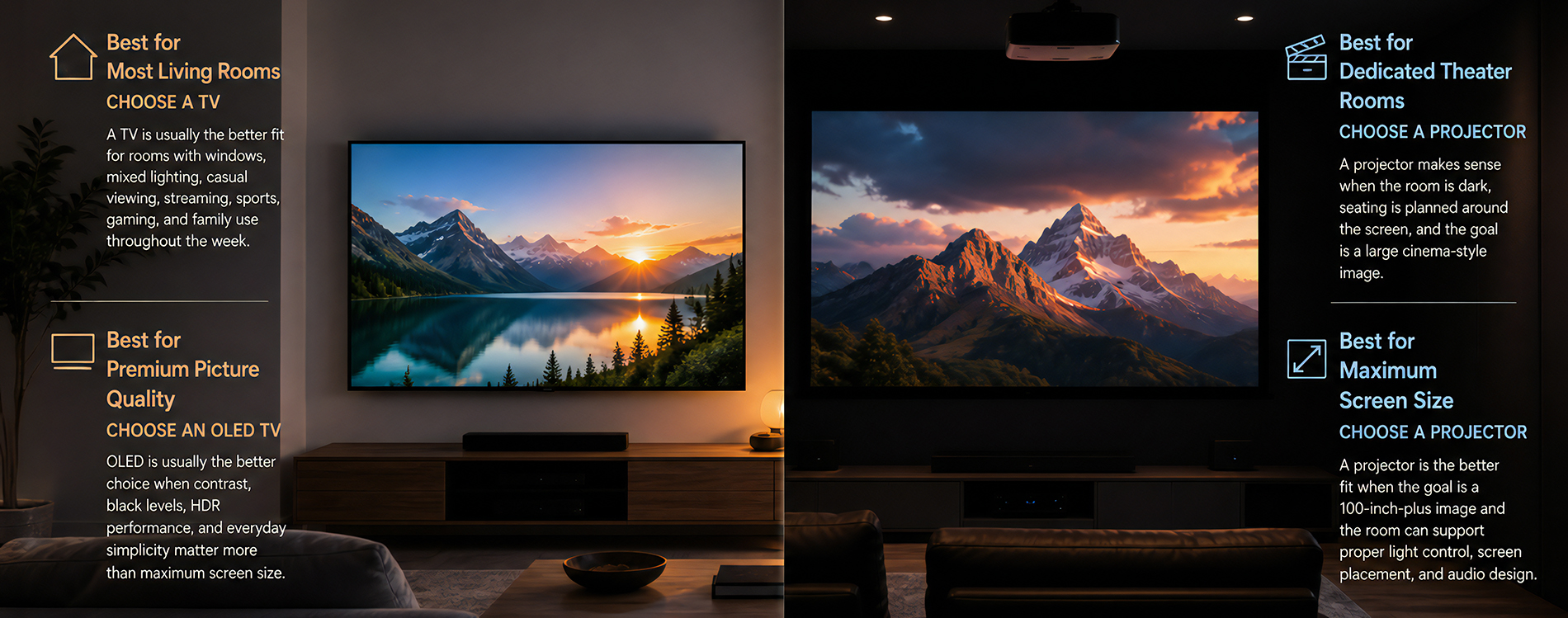
Best Uses for a TV vs Projector
Choose a TV
A TV is usually the better fit for rooms with windows, mixed lighting, casual viewing, streaming, sports, gaming, and family use throughout the week.
Choose a Projector
A projector makes sense when the room is dark, seating is planned around the screen, and the goal is a large cinema-style image.
Choose an OLED TV
OLED is usually the better choice when contrast, black levels, HDR performance, and everyday simplicity matter more than maximum screen size.
Choose a Projector
A projector is the better fit when the goal is a 100-inch-plus image and the room can support proper light control, screen placement, and audio design.
Cost Comparison: The Display Is Only Part of the Price
A common mistake is comparing the price of a projector directly against the price of a TV without considering the full system. The display itself is only one part of the project.
A TV-Based System May Include
- Flat-screen TV
- Wall mount or specialty mounting solution
- Power relocation or clean power access
- Concealed cabling
- Soundbar, architectural speakers, or surround sound
- Network connection
- Smart-home or remote-control integration
A Projector-Based System May Include
- Projector
- Projection screen
- Ceiling mount or specialty mount
- Long HDMI or video cable runs
- Power at the projector location
- Receiver, processor, or source switching
- External streaming device
- Surround sound system
- Lighting control
- Screen control
- Calibration and room adjustments
A projector can still be a smart investment in the right room. But projectors often require more supporting infrastructure to perform at their best. In many homes, a large premium TV provides a cleaner balance of image quality, simplicity, installation efficiency, and long-term reliability.
What Automated Living Recommends
For most home environments, Automated Living generally recommends a premium flat-screen TV. TVs offer excellent picture quality, strong performance in real-world lighting, simpler daily operation, and a cleaner long-term ownership experience.
That recommendation is especially true for shared living spaces, great rooms, family rooms, bonus rooms, sports spaces, gaming setups, and media rooms that are not fully light-controlled. In those rooms, a large TV usually gives homeowners the best blend of performance, reliability, and ease of use.
Projectors remain an excellent option for dedicated theater rooms. When the room is designed around projection, a projector can create a cinematic experience that feels larger and more immersive than a TV. The difference is that a projector should be planned as a complete system, not just selected as a display.
The right home theater is not only about screen size. It is about how the display, audio, lighting, network, and control interface work together. Automated Living designs systems with that complete experience in mind, so the room feels intuitive every time it is used.
FAQ About Projectors vs TVs
Is a projector better than a TV for a home theater?
A projector can be better for a dedicated theater room where screen size and cinematic immersion are the top priorities. For most living rooms and shared media spaces, a TV is usually better because it is brighter, easier to use, and more consistent in everyday lighting.
Is a TV better than a projector for everyday use?
Yes, a TV is usually better for everyday use. It performs well in more lighting conditions, turns on quickly, includes smart features, and works well for streaming, sports, gaming, and casual viewing.
Is OLED better than a projector?
OLED is usually better for picture quality because it offers excellent contrast, deep black levels, sharp detail, and strong HDR performance. A projector can be better for very large screen sizes, especially in a dark room designed for projection.
Why do projectors look worse in bright rooms?
Projectors rely on reflected light from a screen. When daylight, lamps, or other ambient light enters the room, it can reduce contrast and make the image look less rich. TVs create light directly from the display, which helps them perform better in bright or mixed-light spaces.
Are large TVs replacing projectors?
Large TVs are replacing projectors in many living rooms and media spaces because they are simpler, brighter, and easier to live with. Projectors still have a place in dedicated theater rooms where very large screen size is the main goal.
Is a projector cheaper than a TV?
A projector may appear less expensive when only the projector and TV prices are compared. However, a complete projector system may also require a screen, mount, cabling, power, audio equipment, lighting control, and calibration. The full system cost should always be considered.
Can a projector work in a living room?
A projector can work in a living room, but the room needs to be evaluated carefully. Window placement, light control, screen type, seating distance, ceiling height, and audio design all affect the result. In many living rooms, a large TV is the cleaner and more reliable choice.
What is better for sports: projector or TV?
A TV is usually better for sports because it performs well in brighter rooms, handles fast motion clearly, and is easier to use for casual viewing during the day. A projector can be impressive for big game events in a dark theater room, but it is less flexible for everyday sports viewing.
What is better for gaming: projector or TV?
A TV is usually the better gaming choice because many modern TVs offer strong brightness, low input lag, high refresh rates, and direct compatibility with gaming consoles. Some projectors can work well for gaming, but the setup needs to be selected carefully.
Should I choose a projector or smart TV?
Choose a smart TV if the room will be used often for streaming, sports, gaming, and everyday viewing. Choose a projector if the room is dedicated to theater-style viewing and the goal is a much larger image with controlled lighting.
Can Automated Living help design a TV or projector system?
Yes. Automated Living designs and installs home theater, audio/video, networking, lighting, security, and smart-home control systems across Western Montana. The right display is selected as part of the complete room experience, not as a standalone decision.
Plan the Right Display for Your Home Theater
The best home theater display is the one that fits the room, the viewing habits, and the long-term expectations for the system. For many homeowners, that will be a large premium TV. For others, especially in a dedicated theater room, a projector may still be the right choice.
Automated Living helps homeowners across Western Montana design clean, reliable entertainment systems that are easy to use every day. Whether the right solution is a premium OLED TV in a shared living space or a projector in a purpose-built theater room, the focus is the same: thoughtful design, clean installation, intuitive control, and dependable long-term support.
Ready to Plan Your Home Theater?
Talk with Automated Living about the right TV, projector, audio, lighting, networking, and control solution for your home.